


I’m trying to wrap my head around this provider’s thought process, but I’m struggling to see how her actions are beneficial for anyone involved. Based on...
I’m trying to wrap my head around this provider’s thought process, but I’m struggling to see how her actions are beneficial for anyone involved. Based on her post, it’s clear she’s upset—and understandably so—but I fail to see how publicly threatening to share this client’s personal information achieves anything positive.
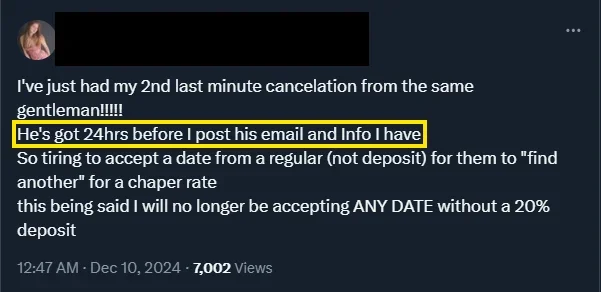
Here’s the situation: The provider is frustrated because a regular client canceled on her twice without a deposit to compensate for the inconvenience. As a result, she’s lost time and income. Having known this client for seven years, it seems she feels betrayed—likely because she trusted him not to behave in a way that she now interprets as disrespectful. Again, her frustration is valid. However, threatening to expose his personal information is where things take a troubling turn.
This feels like an overly emotional response to a situation that, while irritating, doesn’t warrant such an extreme reaction. Refusing future bookings with this client would be the simplest and most professional course of action. But instead, she’s considering something that could severely harm his privacy and, in the long run, damage her own reputation.
Sharing a client’s personal information reflects poorly on the provider, not just the client. It sends a message to the community that their privacy may not be safeguarded, which is a foundational aspect of the trust that allows this hobby to function. For many clients, that trust is already fragile, and actions like this only exacerbate the problem. She says that she'll put his information on the proper forums, which she is allowed to do, but this shows potential for more.
Yes, being canceled on is frustrating. It’s a waste of time and energy, especially when no deposit was in place to mitigate the loss. Providers who require deposits have a system to address this, and those who don’t are taking a risk—one that, unfortunately, sometimes doesn’t pay off. But at the end of the day, canceling—while inconvenient—is not a crime. It doesn’t warrant a disproportionate response that could have long-term repercussions for all parties involved.
In my opinion, the best takeaway from this situation is to learn the lesson and move on. Tighten your policies, require deposits even from regulars if necessary, and, above all, avoid actions that could tarnish your professional reputation. Threatening to reveal personal information may feel like justice in the moment, but it often causes more harm than good.
Here’s the situation: The provider is frustrated because a regular client canceled on her twice without a deposit to compensate for the inconvenience. As a result, she’s lost time and income. Having known this client for seven years, it seems she feels betrayed—likely because she trusted him not to behave in a way that she now interprets as disrespectful. Again, her frustration is valid. However, threatening to expose his personal information is where things take a troubling turn.
This feels like an overly emotional response to a situation that, while irritating, doesn’t warrant such an extreme reaction. Refusing future bookings with this client would be the simplest and most professional course of action. But instead, she’s considering something that could severely harm his privacy and, in the long run, damage her own reputation.
Sharing a client’s personal information reflects poorly on the provider, not just the client. It sends a message to the community that their privacy may not be safeguarded, which is a foundational aspect of the trust that allows this hobby to function. For many clients, that trust is already fragile, and actions like this only exacerbate the problem. She says that she'll put his information on the proper forums, which she is allowed to do, but this shows potential for more.
Yes, being canceled on is frustrating. It’s a waste of time and energy, especially when no deposit was in place to mitigate the loss. Providers who require deposits have a system to address this, and those who don’t are taking a risk—one that, unfortunately, sometimes doesn’t pay off. But at the end of the day, canceling—while inconvenient—is not a crime. It doesn’t warrant a disproportionate response that could have long-term repercussions for all parties involved.
In my opinion, the best takeaway from this situation is to learn the lesson and move on. Tighten your policies, require deposits even from regulars if necessary, and, above all, avoid actions that could tarnish your professional reputation. Threatening to reveal personal information may feel like justice in the moment, but it often causes more harm than good.